Pages

Monday, May 31, 2010

Meatless Monday* - When the Moon Hits Your Eye ...

PIZZA!


For some reason, when I was a kid, I didn't really like pizza. Maybe it's because (as my friends will tell you) I have a contrarian streak and a kid's favorite food is supposed to be pizza. Or maybe it's because the pizzas one eats as a kid -- pepperoni, cheese, mushroom and olive if you're really adventurous -- just aren't that exciting.

There is one thing that I liked about pizza, though -- making it with my mom. Because we lived in the country and very small towns, where delivery pizza was not available (and because people just made more homemade stuff then), my mom often made pizza from scratch. I remember carefully arranging mushrooms and pepper strips so that they were evenly distributed on the homemade crust. Mom always made our pizza in big rectangles on a cookie sheet, and round pizza seemed very exotic to me.

Lately, as I've been trying to create a more "from-scratch" relationship with food, pizza seemed a bit daunting. However, Mom declared "Making pizza crust is easy!" So I thought I would give it a whirl.

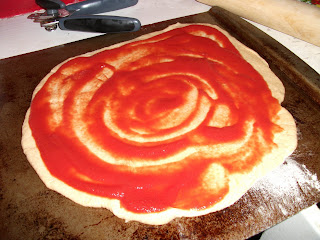
I used this easy recipe from Allrecipes.com, and found that, yes, indeed, mom was right. Making pizza dough IS easy. Best of all, this recipe makes enough for two medium pizzas. You can divide it in half and freeze one half. Then you just bring the dough to room temperature and prepare as directed.

One of the best things about pizza is that, if you're venturing into meatless eating, vegetarian pizza options won't make you (or your kids!) feel like you're giving anything up. There are a variety of delicious variations:

CHEESE
When I was teaching, cheese pizza was the favorite of almost all kids. For an early foray into meatless eating with children (or skeptical adults), why not try the traditional red sauce and mozzarella?

MEDITERRANEAN
For more sophisticated palates, there's nothing better than basil, fresh tomato, and goat cheese. On the version you see below, I also added portobello mushroom slivers and red onion. I recommend putting on the basil right after the sauce, then covering it with the other ingredients -- otherwise it will get dried out in the oven.

STUFFED
The stuffed pizza you see below looks decadent, but it's actually a variation of a Weight Watchers recipe. Divide your pizza dough in half and roll out one half. Fill with your favorite toppings (this is a package of frozen spinach, part-skim ricotta, feta, and sauteed scallions). Then roll out the second half of your dough and lay it over the top. Crimp the edges together, cut a few holes in the top crust to let steam escape and bake. You will bake a little longer than a flat pizza -- until the filling is bubbling.


I served the stuffed pizza with a tomato-olive quick relish. Chop up a bunch of grape or cherry tomatoes and discard the seeds and liquid. Also chop 3-4 olives -- Greek mix or kalamata. Mix in a bowl with about a teaspoon of olive oil and one-half to one teaspoon of balsamic vinegar. Put it in the fridge for an hour or two to let the flavors meld. Then, spoon it over your pizza.

PEAR
My friend Melanie loves the pear-gorgonzola pizza from California Pizza Kitchen. You can make your own pear pizza. Use a thin layer of white sauce or just brush the crust with olive oil (For a quick version, you can use the CPK Frozen White Pizza -- but that's no fun and not as sustainable). Add thinly sliced pear, toasted almonds or hazelnuts, and a light sprinkle of cheese. After the pizza is baked, top with a salad made of arugula tossed with olive oil and gorgonzola (or substitute goat cheese for a milder flavor)

OTHER FAVORITES
Any pizza is great topped with a fresh salad of arugula or herbs (after baking). You can make Thai Pizza with the peanut sauce I wrote about on a previous Meatless Monday. Barbecue sauce, red onions, and cheese is an all-American version. And if you can't give up your meat, try Field Roast meatless sausages instead (I swear, they pay me no money).

For the future, I've been eying the Shaved Asparagus Pizza that smitten kitchen wrote about last week. I've also come across several recipes for caramelized onion and fig pizzas that sound delicious.

What do you like on your pie?

* Meatless Monday is a movement to increase awareness of sustainable, meat-free eating, by eating meatless meals on Mondays. So alliterative!

Tuesday, May 25, 2010

Snap ... Crackle ... Slurp

I don't think my friends would call me a materialistic person, but I do love well-designed stuff. It seems to me that there are few things in the world that really just do exactly what they were designed to do. Here are a few recent favorites:

Snap
I want to say just one word to you. Just one word.

Are you listening?

Plastics.

OK. When have you ever known me to say just one word? About anything?

That little quote from The Graduate expresses the hope that we once had about plastic. And it is a miracle invention. It allows us to make things like cell phones, cheap and clean syringes that save lives, and Barbie dolls (remember those wax dolls they had in the Little House books? Melty). But plastic has a down side. Plastic is usually made with petrochemicals (hello! BP oil spill!) and unfortunately, when heated, many types of plastics leach chemicals which are thought to be carcinogenic.

That's why I love my new Glasslock food storage containers:

They are glass, as you might assume from the name, but have airtight plastic lids that snap on. They are also microwave safe (remove the lid to avoid the plastic leaching) and dishwasher safe, which doesn't matter, since I don't have a dishwasher. They are also quite sturdy, as I've dropped them in the sink numerous times already -- and I've only had them for two weeks.

Crackle
But plastic has its place. Don't you just love the crackling, crinkling sound of a reusable shopping bag made of recycled plastic?

For example, a friend used this giant reusable bag (from Walgreen's) as a gift bag at my birthday.

It's made of 80% post-consumer waste, and it's so big that it makes a great multi-use bag. It can be used for shopping, beaching, or, if you're a cat - diving into.

Slurp
As a child raised in the Pacific Northwest, I was mainlining Starbucks mochas at an early age. You could probably fill a landfill with all of the paper cups I've used. In the last couple of years, I've gotten much better about using my "personal cup" (as the baristas call it), bringing my own coffee tumbler to Starbucks and my local independent coffee shops.

In the summer, however, I don't want a hot cuppa joe. I wanna icy drink to cool me off. And those don't fit into those reusable coffee cups. As the weather warmed up this year, I began to feel guilty because I was ordering iced drinks that come in clear plastic cups.

Then, voila! These appeared at Starbucks:

They are reusable cold cups. They are double-insulated, so your drink stays cold and they don't sweat all over your desk. And, I swear that drinks just taste better in this cup. Unfortunately, I couldn't find them online. You'll have to check out your local Starbucks -- the baristas have twice told me how popular they are.

Monday, May 24, 2010

Live Together, Die Alone

Or, In Which Catfish Explicates a Tenuous Connection Between Lost, Community, and the green movement.

I remember one time, as we were leaving the movies, when my mom said something like: "I like stories where a bunch of different kinds of people become a family."

I don't remember what movie she was talking about, but I certainly remember her statement. And I thought, I like those stories too.

Lately, I've been watching back episodes of the show Community (which I wrote about recently). I watched it all year, but I've been re-evaluating it in terms of the Lost credo: Live together, die alone. OK, so no one on Community is going to die alone (at least, I hope not, because that would be an AWFUL sitcom), but the show does explore the idea that when thrown together, disparate individuals can become a quasi-family. And this quasi-family can make one consider capital-O Others in a way you never would have before.

Lost, which had its series finale last night, more seriously addressed the same theme. When we are stuck together (on a freaky island, on an airplane, in Los Angeles) the need for survival allows our basic humanity to overcome our differences. We know we have to die alone; so in the meantime, we'd rather live together.

Lost is known to be mind-bending. Confusing. Weird. But those of us who watched it for years didn't do so just so we could figure out the puzzles. We did so because we were drawn into the story of human connection. Disparate individuals -- some not even speaking the same language -- becoming a quasi-family.

So many of the stories we're presented (especially on TV) are about people who are basically similar (from Friends and How I Met Your Mother, to 30 Rock and Grey's Anatomy) and how they deal with subtle differences in personality. But there are a few stories being told in which the larger human differences (race, class, nationality) are addressed and OUR HEROES still manage to realize they are a family.

The philosopher Alphonso Lingis writes of these random connections thusly: "We were on opposite extremities of humanity, linked by no culture, language, faith, enterprise, race, blood, or age. Across these most remote distances he had come to put his life in the place of my death. This substitution across the unmediated distances seemed to me to seal a bond of the most extreme kind, an absolute bond ..."

I want more of these stories about absolute human bonds. More stories where a bunch of people who don't even believe in the same God have to mutually save each other. More stories where American TV has to have subtitles because the characters don't speak the same language, but live next door to one another. More stories where smoke monsters chase people through the bamboo ... wait. That doesn't have anything to do with my point. More stories about the places where we all come together.

Ultimately, it is by learning the lessons of these stories, both silly and serious, that we will learn that we're all responsible for one another. Until that happens, I'm afraid our green movement can't get far.

Saturday, May 22, 2010

In the 'Hood

One of the things I love about living in Houston is that you're constantly reminded that nature cannot be ignored, no matter how many strip malls and parking lots get built. The second man turns his back in Houston, nature comes roaring to life.

Just look at the vines and grass around these abandoned buildings:


And check out the blossoms on this cactus:


Tuesday, May 18, 2010

Green Eyes

When I was a teacher and taught the poetry unit, we helped the kids learn to see with poets' eyes. To see with poets' eyes meant that:

  • if you looked at a spiral seashell, you might see a princess's tower
  • if you looked at a ladybug, you might see her entire life cycle
  • if you looked at a swordfish, you might see a gallant knight
  • if you looked at a flower laden with dew, you might see a tear
Similarly, if you see with green eyes, you might see how trash can be renewed with a little ingenuity.

Because I am klutzy, I recently dropped and broke one of my favorite Ironic Deer Family Salt 'n' Pepa Shakers:

Weep for Bambi's Mom!

However, looking at the piece of junk with green eyes, I saw the possibilities!

While I would never want a real hunting trophy on my wall, a ceramic trophy is just my style:


Saturday, May 15, 2010

Weekend Interweb Round-up

I love the weekend - sitting around, drinking coffee, wasting WAY too much time on the internet. Here are a few of my recent internet finds:

  • Lots of people have asked me where I got the stone paper notebook that I wrote about in August. The answer is Walgreen's, but I haven't found any stone paper there since I originally bought the notebook. (In case you're wondering, stone paper is usually made with limestone that's a by-product from other manufacturing processes and uses much less water than normal tree paper). However, today at Target, I found lovely stone paper notebooks (decorated with an adorable floral motif) for sale, as well as banana paper, and regular recycled notebooks. Go, Target! I tried to find them online for you, but they didn't seem to have them. If you want one, you'll have to go to your local Target. However, Walgreen's online is selling stone paper notebooks online now.
  • The New Yorker has a short piece on the size of the Transocean oil spill, accompanied by some eye-opening flyover video. And if watching that video bums you out, I recommend you head over to the Oceana website. Oceana is a non-profit that works to protect the world's oceans and marine wildlife. On their website, you can sign a petition to stop off-shore drilling, donate to the cause, or find out about other ways to help. While efforts to staunch the flow of oil continue to fail, making those of us in the greenosphere feel helpless, it's good to be able to do something, even if it's just to send some money through PayPal. (In case you're wondering, Oceana has a four-star rating from Charity Navigator).
  • Speaking of Charity Navigator, I've come to love this website! It rates charities by how efficient and effective they are. They have dedicated a page to organizations that are helping address the oil spill. Check them out, and you'll find lots of great organizations that are working to solve problems that might spark you compassion.
  • With all of this depressing news, you might want to cheer up. If so, I recommend watching the "Modern Warfare" episode of NBC's Community. This doesn't have anything to do with being green, really (although the show's themes of whether morality is subjective or objective, and what that means for us as beings who live in community with one another, is inherently of interest to greenies). I just think you should watch it. This episode was filmed as an "action movie" (taking place during an epic game of paint ball), and was even directed by action director Justin Lin. The half-hour is pure comedy genius, both celebrating and satirizing the action movie cliches that so many of us grew up with. It's amazingly shot, hilarious, and -- who'd have thought Joel McHale had those guns?
What have you found on the interweb lately?

Monday, May 10, 2010

Meatless Monday* - Crack Ramen


Remember in college, when ramen was a food group? If you had money, Maruchan Ramen was your brand. But if you were poverty-stricken like most of us, Smack Ramen was the brand for you. Well, in tribute to Smack Ramen, I've named this recipe Crack Ramen -- because the broth is like crack. Once you start eating, an addiction follows shortly.

I have a deep love of ramen, partly because all through high school my mom often brought us ramen for our daily breakfast in bed (I know, I know ... about twenty things are weird with that sentence. Just go with it). And, as you constant readers know, I love the films of Hayao Miyazaki, not least of all because of the noodle-slurping scenes in some of his movies. A few months ago, when master noodle-chef David Chang came out with his cookbook, Momofuku (named after his restaurant, which, in turn, is named after the inventor of instant ramen), and NPR ran a series on ramen, I became hooked on the idea of creating my own ramen.

Chang's ramen is served with a broth composed of a whole chicken and pork butt. Hmm ... not really my thing. So I began a culinary quest to create a broth that was vegetarian and could be made with readily-available ingredients. Unlike many of my recipes, this one took a few tries to come together. However, I'm really happy with the result, although it's not traditional ramen. It's got a chili-ginger-lime-flavored base, and it's a tangy refreshing meal. It's a nice light dinner or lunch.

どうぞめしあがれ !

(Omniglot tells me this means "Enjoy Your Meal" in Japanese, but if Omniglot is lying, pardon me, please).

Crack Ramen - Chili-Ginger-Lime Ramen with Marinated Salad

Ingredients**

Broth
1 tsp. sesame oil
A large hunk of ginger, grated, to produce about 3 tbsp.
6 scallions, chopped
1 jalapeno, chopped
4 small limes. Squeeze 3 for juice. Cut the rind of the fourth and quarter it.
1 carton vegetable broth
rice wine vinegar
soy sauce
sugar

Marinated Salad
Suggested veggies per serving (but you could substitute your favorites):
Broccoli slaw (sold pre-cut at most supermarkets)
1 escarole
3-4 grated radishes
1/2 cucumber
2-3 sprigs basil
Marinade:
Lime
Rice wine vinegar
Chili sesame oil (optional)

Noodles
Your favorite packaged noodles (you could use instant ramen without the spice packet, soba, rice sticks, or whatever strikes your fancy)

Broth:

In a saucepan, heat 1 tsp. sesame oil. Don't let it get too hot (it will become brown). Add the grated ginger, chopped scallions and jalapenos to the oil. Saute for a minute or two. When the mixture is sizzling, add the juice of the three limes.

Pour in just enough veggie broth to cover. Simmer this for 3-5 minutes.

Add 4 tbsp. rice wine vinegar, and 1/2 -1 tbsp soy sauce. Don't go overboard with the soy sauce. It will make the broth bitter. Add about 3/4-1 cup of veggie broth and simmer about 5 minutes.

Place the quartered lime in the pot. Simmer 5 more minutes.

Add 2 1/2 cups broth. Return the mixture to a boil. Taste. If it seems bitter, add 2 tbsp. sugar. Remove the lime. Cover and simmer for about 20 minutes.

While it simmers, make the ...

Marinated Salad


In a small bowl, with a fork, mix the juice of 1 lime, a couple of glugs of rice wine vinegar, and 2-5 drops of chili sesame oil. That's your marinade.

Toss all of your veggies together in a bowl. Pour the marinade over the top. Stick this in the fridge while the broth is simmering.

Noodles

Cook your noodles according to package directions. Be sure they don't become too gummy, which can happen if you overcook Asian noodles.

To Serve

Spoon about a cup hot broth into a bowl. Drop in the noodles. Top with the salad. Eat with chopsticks and grab a spoon for the broth.

* Meatless Monday is a movement to increase awareness of sustainable, meat-free eating, by eating meatless meals on Mondays. So alliterative!

** Of course, your meal will be more sustainable the more organic and local choices you make in your ingredients.

Sunday, May 9, 2010

The Squirrel and the Mockingbird


Three Short Stories with Interpretation

Since last weekend, when I wrote the Tell Me a Story post (if you haven't read that one yet, you may want to before this one), I've been thinking a lot about what else I wanted to say on the subject of story-telling and living green. Note, I usually try not to be too preachy or too long-winded, but this might be a little of both. Luckily, I've got stories to go along with the philosophizing!


Story 1
Ethics

When I was twenty or so, I took a brief sojourn into community college, after some hasty decisions left me without college money for a year. I loved community college, and there I took the hardest two classes of my life, taught by Dr. C.

One of those classes was Ethics. All quarter, we learned about different theories trying to explain why some actions are considered right and others wrong. We hung out with the Stoics, pondered with Alyosha from Karamazov, took leaps of faith with Kierkegaard, and took dutiful walks with Kant. We considered ethics of utility (Mill) and the ethics of fellow feeling (Hume). The class was difficult, and by the end I think only about six of us showed up regularly. The final day, we were scheduled to have our finals returned, and Dr. C. told us we could ask him whatever we wanted about ethics, even ask him which philosophy he believed in. He passed out the finals, and then asked if we had any questions. We did -- oh... I'm sure we did. We all wanted to know what the dry-humored Dr. C. realy believed. But all six of us were mute with anxiety. Why? I have no idea. After a long silence, Dr. C. said that if we didn't have any questions, we could go. He picked up his things. Just before he hit the door, he turned to us and said: "It's Hume, by the way."

And he walked out.

If you were to ask me what I believe about why some things are right and some are wrong, I would say -- I believe in stories. As I wrote about in my previous post, we seem to be primed (by nature or nurture, I don't know) to favor stories that fit a sort of universal structure -- known as a story grammar by researchers. I think we determine right and wrong by whether we can fit actions into a story grammar.

Our whole legal system is based on this idea. Two opposing sides tell stories, and the one who tells the story that best conforms to certain principles is the one that's judged "true." As a society, we don't really seem to believe in absolutes. I mean, we say we do. We say that killing is bad, that stealing is wrong. But if I can tell you a story that makes sense ("I stole the bread because my babies are starving") I'm likely to be forgiven. If my story doesn't make sense ("I stole the bread because I was making a bread sculpture"), I get the book thrown at me.

OK, Catfish, I bet you're thinking. This little lecture from you scholarly days is all well and good. But what about living green?

That brings us to ...

Story 2
The Lorax and the Truax

Once upon a time, a beloved children's author wrote a book called The Lorax. The lorax is about a magical creature who tries to save a forest from devastation, and he speaks the unforgettable words "I am the Lorax I speak for the trees. I speak for the trees, for the trees have no tongues." Children loved the book, but when some folks in the timber industry realized the book had an environmental message, they became incensed with the suggestion that clear-cutting and over-consumption might be bad. The book was banned in libraries in some timber communities.

But they realized that just keeping the story of the Lorax from the children was not enough. The only way to fight the truth of a story is to provide a counter-story. So several timber industry groups got together to fund that story. It's called The Truax. In it, a wise logger tells a foolish creature named Guardbark about all of the good that logging can do. Now teachers have an alternative to share with students who might be swayed by the Lorax's call to stop over-consumption!

The Truax is not a good book (it's also implicitly racist in its caricature of Guardbark, but that's a matter for another time.) And I don't think it will ever outsell Dr. Seuss's read-aloud classic, The Lorax, especially since it's free. However, it represents something that I think anti-environmentalists do much better than we do: control the narrative.

The Lorax makes narrative sense. It is simple and clear. Any kid, reading it, would think - hey, cutting down all the trees is bad. We should not do that. I used to read it to my students, and they usually got the message of the story without much prompting. That's the power of narratives that fit the story grammar embedded between our ears. We hear the messages, loud and clear.

The people who wrote The Truax knew that, and so they set about attempting to control the narrative. In the case of Lorax v. Truax, it's one simple story against another. However, much of the time, anti-environmentalists are telling simple, clear stories with obvious messages (Scientists who study global warming are liars who falsify data, thus they cannot be trusted; Protecting America is the most important thing and for that we need oil, even if oil rigs sometimes blow up; environmentalists hate America and want you to be deprived of your right to consume whatever you want) -- they're telling a children's story. On the other side, we, the greenies, are trying to tell a story that's more like a Quentin Tarantino movie. We're presenting evidence from multiple sources, projected timelines, using historical data, and asking you to radically change your ways while excusing the fact that there might have been some shady emailing going on in East Anglia. While I think a story of subtlety and nuance better represents the world we live in, it doesn't have the feeling of "rightness" that a simpler story, with clear cause-and-effect, does.

Story 3
The Squirrel and the Mockingbird, or
Zen in the City


So yesterday, I went for a walk and heard a commotion above me. I saw a squirrel running along a wire. And then I realized that the squirrel was being chased by a mockingbird. The mockingbird was flying loopy-de-loops, like Snoopy the World War I flying ace, dodging over and under the squirrel, chirrupping and pecking away. The squirrel leaped for a tree and for a moment I lost sight of them in the leaves, which shook as the mockingbird continued to dive bomb. A moment later, the squirrel emerged from the tree on another wire. He kept running. The mockingbird continue to lay chase.

So, who's the squirrel? Who's the mockingbird? And is it better to be a squirrel or a mockingbird?

So, we're the squirrel. We know what we want. We just want to run on the wire and get where we're going (protect the earth. Avoid global catastrophe). But there's a damn mockingbird pecking at us. It's making us veer off course. We're doing dumb stuff, like agreeing to more offshore drilling as part of a "comprehensive" energy plan. We look like jerks, because we suggest that the oil spill might be good because it's a wake up call. We confuse people, because we don't answer simple questions, like, "Paper or plastic?" without a lot of hemming and hawing and jargon. And it's happening because we're refusing to control the narrative. We just keep running, but we never really get anywhere.

Instead of continuing to run, it's time to turn around and punch that mockingbird in the face.

We need to buck up, and start telling our story. It's a good one, and if we tell it correctly, it fits the story grammar. It's a story that any kid can understand: Cause: Our lifestyle means chemicals, trash, manufacturing by-products and other sludge are filling the air, water, and land. We change the surface of the earth. Effect: Turtles are choking. Kids have asthma. World temperatures are rising. Polar bears are drowning. People are dying in floods, famines, and hurricanes. Solution: We have to change our lifestyle so that others don't die.

Until we're willing to come right out and say what's going on, no one's going to change. If my story is, I'm going to choose a plastic bag because it doesn't make much of a difference anyway... well, I won't do anything differently. But if my story is this: I chose a plastic bag and my plastic bag just choked a turtle -- well, why wouldn't I at least try to change? Unless I hated turtles. But come on. Turtles are cute.

Coming up: Whew! OK, now that I'm done with that, I'll be back to my usual fun-loving, DIYing, cooking self. Expect more meatless recipes, some macabre decor tips, and a green summer beverage round-up!